
Two Companies, One Technology: Why Digital Transformation Succeeds or Stalls
The obstacles that separate leaders from laggards are organizational, not technological — and all three are within your control
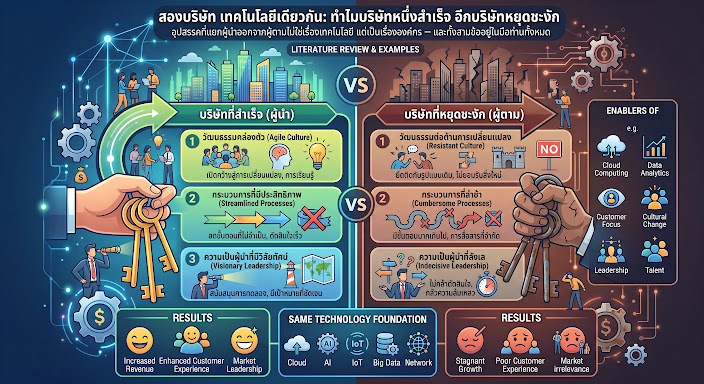
The Gap Between Ambition and Readiness
Two companies in the same review tell the whole story. Company A, a global retailer, rebuilt its e-commerce platform, used customer data to run personalized campaigns, applied predictive analytics and IoT devices to optimize inventory and logistics, and deployed chatbots and virtual assistants for support — and saw meaningful gains in online sales, engagement, and operational efficiency. Company B, a mid-sized manufacturer, recognized exactly the same need and stalled. Its existing systems were outdated and incompatible with modern digital technologies, integration slowed everything down, it hesitated to place sensitive information in the cloud or share data with third-party vendors, and it could neither hire nor retain people with the required digital skills. Notice what did _not_ differ between them: the available technology. Cloud computing, big data analytics, AI, and IoT were equally accessible to both. What differed was organizational readiness. This is the point senior management most often misses when reviewing a transformation proposal. Digital transformation is defined in the research as using digital technologies to create new or modify existing business processes, culture, and customer experiences to meet changing business and market requirements — and _culture_ sits in that definition alongside processes for a reason. The question that predicts outcomes is not "which technologies should we adopt?" but "what in our organization will prevent these technologies from working?"
Three Obstacles, Three Categories of Opportunity
The research is precise about the barriers, and each has a distinct signature. Legacy systems are frequently incompatible with modern digital technologies, often lack the scalability to handle large data volumes, consume budget and time in maintenance that could fund new initiatives, and generate employee resistance among staff accustomed to the old way of working — a technical problem with a human tail. Data privacy and security exposes organizations to new threats including breaches and cyberattacks, while regulations such as GDPR and CCPA impose strict compliance requirements; ensuring data quality, accuracy, and integrity is difficult without proper data governance already in place. The skills gap reflects a genuine shortage of professionals in data analytics, AI, and cybersecurity, requiring investment in training and upskilling — and retention is its own problem, since employees with these skills can leave for more competitive salaries and clearer advancement. Against these sit three categories of opportunity. _Enhanced customer insight_: analyzing data at scale to personalize products, services, and campaigns; gathering real-time feedback through social media, reviews, and surveys; and using predictive analytics to anticipate needs rather than react to them. _Operational efficiency_: automating repetitive tasks such as data entry and processing, digitizing and integrating processes to reduce errors, and cutting cost by eliminating paper-based workflows and optimizing resource allocation and inventory. _Innovation in business models_: developing new offerings on AI, IoT, and blockchain, opening revenue streams through subscriptions and digital marketplaces, and collaborating with partners, suppliers, and customers to build new value propositions. Two further shifts shape the context. Customer-centricity has moved from slogan to operating model through journey mapping and omnichannel strategies that integrate online and offline touchpoints. And the COVID-19 pandemic accelerated remote work and digital collaboration — video conferencing, collaboration platforms, VPNs, virtual events — permanently changing how teams work across locations. Looking forward, the research points to AI and machine learning, IoT, edge computing that processes data closer to the source to reduce latency, 5G networks, and blockchain as the technologies that will shape the next phase.
What to Do
The paper's own recommendations translate directly into executive action. First, develop a clear digital transformation strategy aligned to business goals — not a technology adoption list. Second, invest in updating legacy systems and infrastructure _before_ layering new initiatives on top; Company B's experience is the cautionary case. Third, prioritize data privacy and security with robust measures and demonstrable regulatory compliance, and treat data governance as a precondition rather than a cleanup task. Fourth, close the skills gap through training and development programs, and pair that investment with a retention plan — upskilling people who then leave is a subsidy to your competitors. Fifth, adopt emerging technologies deliberately, matched to a defined business outcome. One honest caveat: this is a review of existing literature, and its case studies are anonymized composites rather than audited results — it maps the terrain reliably but cannot tell you the size of your own prize. Which leads to the question worth putting to your leadership team: if your organization were handed Company A's exact technology stack tomorrow, which of the three obstacles — legacy systems, data governance, or skills — would stop you first? And what are you doing about that one this quarter?