
Beyond Automation: Why Digital Transformation Needs a Roadmap, Not a Technology Wish List
5 phases that turn scattered digital investment into a business model competitors cannot easily copy
The Question Most Executives Answer Too Quickly
What does a fire-truck manufacturer have in common with a logistics group, a compressor maker, an elevator producer, and a hygiene goods company? In product terms, nothing at all. What they share is that each used digitisation not to run the old business faster, but to change how the business earns money in the first place. Yet ask ten senior managers to define "digital transformation" and you will get ten answers — and the research confirms why: there is still no commonly accepted definition, and the terms _digitisation_, _digitalisation_, and _transformation_ are routinely used interchangeably. That ambiguity is not academic. It is the reason budgets get approved for tools instead of outcomes. The sharpest clarification comes from comparing digital transformation with Business Process Reengineering. BPR focuses on automating rule-based processes — clearly defined, algorithmic sequences — to reduce cost and improve existing products and services. Digital transformation begins somewhere else entirely: with obtaining data that did not previously exist, and using that data to reimagine whether the old process should exist at all. Airbnb is the cleanest illustration. It owns no hotels. It shifted attention from processes to data, and in doing so made the rule-based logic of the hotel industry optional. The executive test is simple. Automation makes your current process faster. Transformation makes you question whether that process still deserves to be there.
The Five-Phase Roadmap, and What It Looks Like in Practice
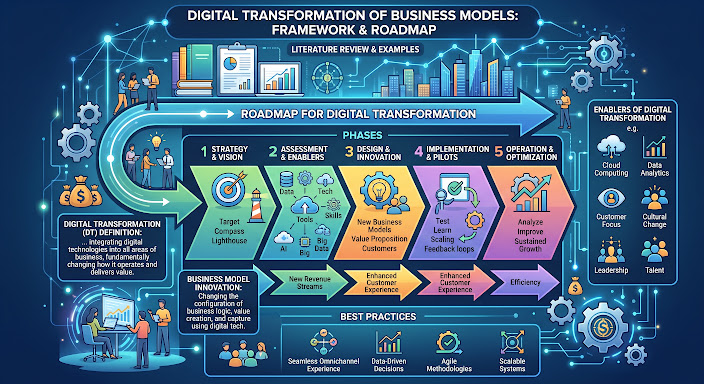
The research offers a structured roadmap in five phases. Digital Reality starts by sketching the existing business model honestly, analysing the value chain and its actors, and gathering current customer requirements — you cannot transform what you have never written down. Digital Ambition sets objectives across four target dimensions: time, finance, space, and quality, then prioritises which business model dimensions matter most. Digital Potential collects best practices and enablers, and derives concrete options for each business model element. Digital Fit evaluates those options against customer requirements and business objectives, then prioritises the combinations that actually cohere. Digital Implementation finalises and executes the model, including the design of the digital customer experience and the digital value-creation network with partners. Underneath sits a five-part view of the business model itself — the customer dimension, the benefit dimension, the value-added dimension, the partner dimension, and the financial dimension — and four enabler categories: Digital Data, Automation, Digital Customer Access, and Networking. ThyssenKrupp's elevator business shows the roadmap working. Its old model was manufacturing, installation, and maintenance on demand. Demand for high-performance elevators rose, users demanded greater reliability, maintenance backlogs became a genuine risk, and competitors began selling high-margin maintenance packages. The response was MAX: sensors fitted to drive motors, doors, and shafts, capturing data such as cabin speed and motor temperature, run through predictive analytics, and delivered to maintenance staff as alerts and concrete recommendations. Downtime fell, maintenance planning improved, and customers proved willing to pay more. Note what happened: information the company had always generated but ignored became a revenue stream — and it touched every one of the five business model dimensions at once.
What to Do Monday Morning
Five practical moves follow. First, write your existing business model on a single page across all five dimensions before approving any technology spend; most transformation failures are diagnosis failures. Second, express your ambition in numbers against time, finance, space, and quality — "become digital" is not an objective. Third, map enablers to _specific business model elements_, not to the company in general; the useful question is not "should we use AI?" but "which element of our model changes if this data exists?" Fourth, screen every option for fit with real customer requirements before scaling — an elegant capability nobody will pay for is an expensive hobby. Fifth, treat this as continual rather than a project with an end date. A caution worth carrying: the researchers themselves note their results may not be fully generalisable across all industries and company sizes. The roadmap is a discipline for thinking, not a guarantee of outcomes — and judgment about your own market remains yours to exercise. Which brings the real question into focus: what information does your organisation already generate every single day and quietly throw away — and what would your sharpest competitor build if they had it instead?